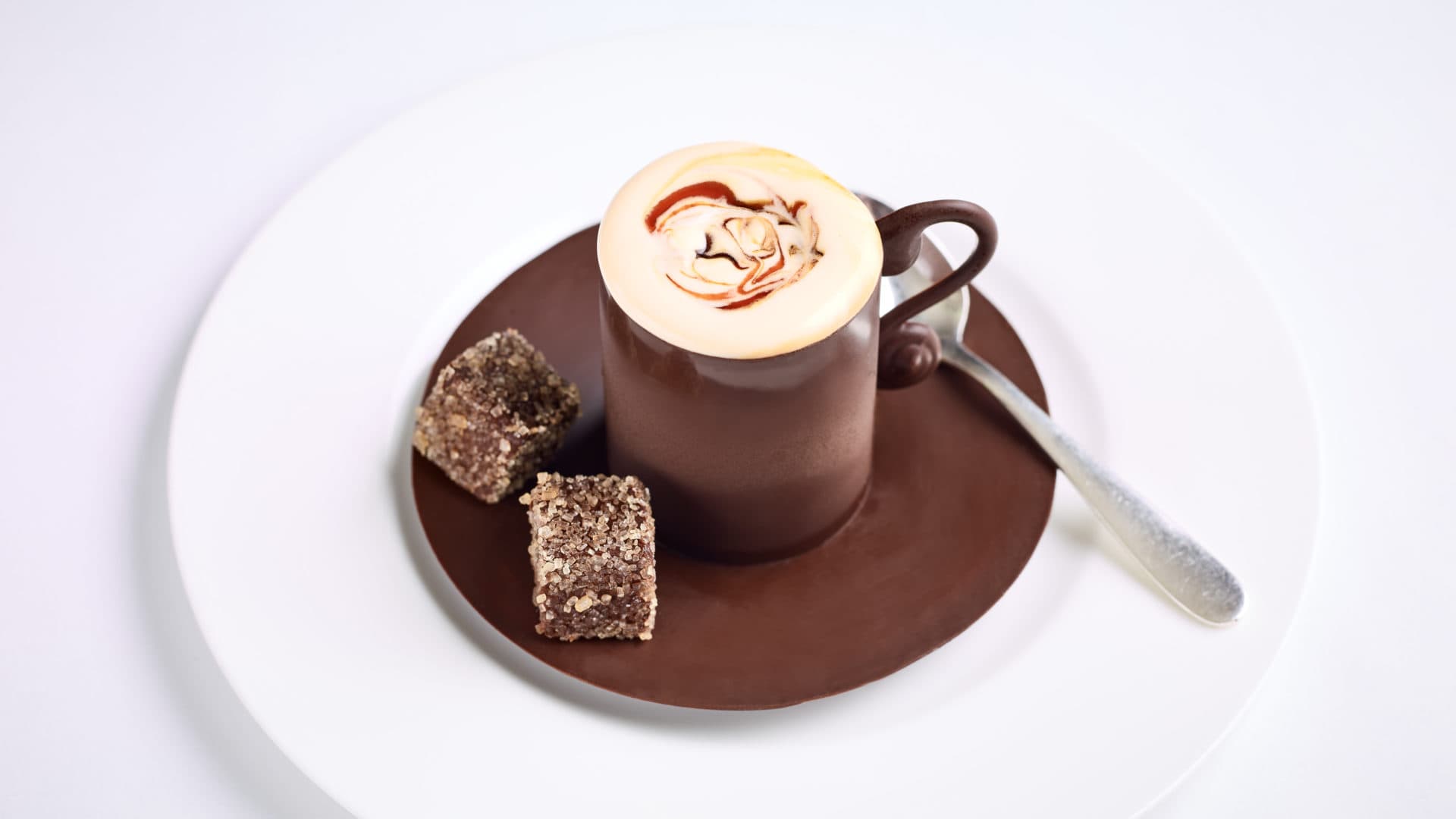
Chocolate coffee cup (café crème)
It's a complex dish but so worth it!
This recipe is from my cookbook: Le Manoir aux Quat'Saisons: The Story of a Modern Classic
Ingredients
For the chocolate cups, saucers and handles:
- 500gDark Valrhona chocolate 65%, chopped
For the biscuit à la cuillère (sponge)
- 2Medium organic or free range eggs, separated whites from yolks
- 40gCaster sugar
- 40gPlain flour
- 20gIcing sugar, to dust
- 50mlEspresso coffee
For the coffee parfait and kirsch sabayon
- 150mlWhipping cream
- 100mlWater
- 120gCaster sugar
- 4Medium organic or free range eggs
- 1 tspCoffee extract or 50g very strong black coffee
- 10mlKirsch
For the sugar cube ganache
- 100mlWhipping cream
- 100g65% dark chocolate, Valrhona, chopped
- 50gDemerara sugar (to coat the ganache cubes)
To finish the dessert
- 20gCaramel or coffee extract
Method
- 1
To temper the chocolate: In a metal bowl set over a bain-marie, melt two thirds (340g) of the chopped chocolate to a temperature of 53ºC. Take off the heat, mix in the remaining third of the chopped chocolate and stir to cool rapidly until the temperature reaches 32ºC.
This process controls the crystallization of the cocoa butter to give the chocolate strength and a wonderful glossy finish when set. It is also the easiest way to temper the chocolate.
Reserve the chocolate at 32ºC. Warm it a little occasionally to achieve this.
- 2
To make the chocolate saucers: Brush the base of four 13cm saucers with a film of oil. This will ease the wrapping process.
Take a piece of cling film and place the saucer on it bottom-side down. Wrap the cling film around, pulling the edges of the film up over the top of the saucer and twisting them together tightly to ensure the underside is completely smooth.
The cling film must be stretched tightly, without any creases. Repeat for the remaining saucers.
- 3
To make the chocolate saucers cont...... Holding the saucer by the twisted cling film, dip the base into the melted chocolate up to the rim then, lifting and holding the saucer vertically with your finger, thin down the thickness of the chocolate to obtain the thinnest possible coating over the cling film.
This will give you the thinnest and finest chocolate saucer. With your thumb and forefinger together, push any excess chocolate away from the rim, so your saucer, once set, will be a perfect shape.
This also ensures that once it is set, the saucer will easily release from the cling film without catching. Lay the saucer on a tray with the chocolate side up, and leave the crystals to stabilise, firm up and set for a minimum of 12 hours.
Repeat for the remaining saucers.
- 4
To make the chocolate cups and handles: Spoon some melted chocolate along the centre of a rectangle of acetate. Using a small stepped spatula, evenly spread the chocolate to create the thinnest possible layer.
Using a paring knife, carefully lift up one corner of the acetate rectangle and hold it by the edges. With the chocolate facing inwards, bend the rectangle round to form a circle, with the edges slightly overlapping.
Slide the chocolate cylinder into a 5. 5cm plastic ring to hold the shape.
- 5
To make the chocolate cups and handles cont...
To ensure that there is a good seal along the join, dip your finger in the chocolate and cover the join with a thin layer.
Stand the ring on a tray lined with greaseproof paper.
Leave to set for a minimum of 12 hours.
Repeat for the remaining cups.
- 6
To make the chocolate cups and handles cont...
To make the handles, fill a small piping bag with a 2mm nozzle with some tempered chocolate (32ºC).
On a sheet of greaseproof paper, pipe S-shaped cup handles 3mm thick and 3cm long.
Leave to set for a minimum of 12 hours.
- 7
To assemble the chocolate cups: Delicately unwrap the cling film from each saucer to release it, then peel the cling film away from the chocolate saucer; use only a gentle pressure as the thin chocolate will break easily.
You will release the most perfect chocolate saucers.
Reserve.
- 8
To assemble the chocolate cups cont...
Now place a saucer in front of you.
Quickly melt the base of a chocolate cup cylinder on a hot tray and place in the centre of the saucer to create a perfect seal.
Repeat for the remaining cups.
- 9
To assemble the chocolate cups cont... The same method is used to attach the handles to the chocolate cups.
Carefully release them from the greaseproof paper. Lightly press the top and bottom of a handle against a hot tray and hold it against the surface of a cup until the chocolate cools and creates a seal.
This will take about 30 seconds, and you will need a steady hand. Repeat for the remaining handles.
- 10
For the biscuit à la cuillère (sponge) Preheat the oven to 190ºC. On a fast speed, beat the egg whites until they form soft peaks.
Gradually add the caster sugar and continue beating until firm. At low speed, add the egg yolks and continue mixing until fully incorporated.
Remove from the machine, then gradually fold in the flour with a whisk rather than a spatula, but do not whisk, or the mix will collapse. This will take no longer than 1 minute.
Line a tray with greaseproof paper. Dip a finger in the mix and dot the tray in each corner with a little mix so that the paper sticks nicely.
Using a palette knife, spread a 1cm layer of the mixture onto the baking tray. Dust the strips of biscuit à la, cuillere with icing sugar, leave for 5 minutes, then dust again.
This will give them a beautiful crust and colour; bake for 8 minutes until ivory brown.
- 11
For the biscuit à la cuillère (sponge) cont...
Once cooked, leave the biscuit à la cuillere to rest for 15 minutes to allow the moisture to be released.
This allows the greaseproof paper to be peeled away more easily.
Use a pastry cutter to cut out four 3cm-diameter discs.
Soak these discs in the espresso coffee and reserve until ready to build the cups.
- 12
For the coffee parfait and kirsch sabayon: In a medium bowl, whip the cream to form soft peaks and reserve in the fridge. In a mixing bowl on high speed, whisk the egg yolks and water for 5 minutes until tripled in volume.
In a small saucepan on a high heat, make a syrup by bringing the water and sugar to 125°C. Lower the speed and pour the boiling sugar syrup between the whisk and the side of the bowl.
It will reach about 70ºC. This temperature is important as it will partly cook the egg yolks and make the sabayon stable.
Raise the speed and whisk until cold. Place the bowl in iced water to cool it down rapidly.
- 13
For the coffee parfait and kirsch sabayon cont... Pour two thirds (250g) of this sabayon into a separate bowl and add the coffee extract or strong black coffee to it, fold-in the whipped cream.
Fill 4 dariole moulds to the top with the coffee sabayon and place in the freezer for a minimum of 12 hours. Reserve in the freezer until needed.
Add the kirsch to the remaining sabayon and reserve until ready to serve. This will be for topping each cup.
- 14
For the sugar cube ganache cont... In a small saucepan over a high heat, bring the cream to the boil, then pour it over the chopped chocolate in a bowl and whisk until smooth.
Pour the ganache into the frame. It must be 1cm thick.
Allow to cool, then refrigerate for at least 12 hours until set. Once set, cut the cold ganache into cubes 2cm wide and 1cm thick and roll each cube in demerara sugar to coat.
Reserve in the fridge until required.
- 15
To finish the dessert: Carefully place the soaked sponge disks in the bottom of the chocolate cups. Dip the bases of the frozen parfait moulds in hot water for 3 seconds.
Run a blade around and against the insides of the moulds. Pierce the middle of each parfait with a small knife blade and turn the blade of the knife and free the parfait from the mould.
This should be done in advance to prevent the parfait from melting. Slide the frozen parfaits into the cups.
Spoon the kirsch sabayon over the parfaits, right up to the rim of the cups. Swirl the coffee extract or caramel on top of each cup.
Place two ganache sugar cubes and a real teaspoon on the saucers… and, with a huge grin on your face and much pride, serve to your guests.
Chef's Tips
“"You could make a large amount of the coffee parfait and freeze it in a terrine mould. Slice to serve. The coffee could easily be replaced with all sorts of other flavours such as any seasonal fruit and liqueurs." "The ganache cubes would be a lovely petit four for a dinner party." "If you have extra sabayon, you can serve it on its own, poured over some seasonal fruit. You can also gratinate it by adding icing sugar and glazing under the grill." "The technique for the coffee cup could be used to create many beautiful simple desserts." The chocolate leaves can be used to create a raspberry, ganache, or praliné millefeuille. Many other shapes can be created, such as tears, leaves etc.
Cooking is always an expression of care and generosity. Enjoy this dish.
Bon appétit!